Bayes Coachlines Limited - History
In 1972, David and Joan Bayes laid the foundation for Bayes Brothers Transport with the purchase of a quarry and their first truck. Specialising in transporting materials like metal, scoria, limestone, and agricultural lime.
The company quickly grew, expanding its fleet and serving routes from Dairy Flat to the Coromandel and Hauraki Plains. Bayes Brothers Transport had a rich history of growth and innovation. The quarry was closed in 1981 and the hole was filled up and re-grassed.
In 1979, the company made a bold move by acquiring Robert’s Transport, Orewa. They bought 4 school runs and 5 school buses from John Kennedy. This marked the beginning of Bayes Transport, (then Bayes Coachlines) and the start of their school bus services. During the 1980’s to 2000’s the company expanded from five buses to dozens incorporating luxury coaches and expanding charter services for schools, clubs and tourists. During this time the next generation of Bayes’ began to get involved in the business (David & Joan’s sons, John & Richard) who took the company to the next level and expanded it further.
By 2009, the fleet had grown to 36 school buses and 9 luxury touring coaches, serving both local schools and offering tours across New Zealand. Many local children travelled to and from school on these buses. By 2025, the company was operating over 80 buses, continuing our legacy of service and expansion. They now operate charter services from depots in Dairy Flat (Auckland) and Christchurch as well as scheduled services around the North Shore. The fleet includes double-deckers, articulated and electric buses. In September 2019 they celebrated 40 years in business with their staff.
By 2023, their sons, John and Richard, continued the family’s proud legacy by launching Bayes Contracting, a return to their roots in transport. With a fleet of modern trucks and machinery, Bayes Contracting has rapidly grown, building strong, lasting relationships with clients and business partners. Caleb Bayes, now the third generation and serving as Operations Manager, continues to uphold the core family values of quality, reliability, and integrity.
The Bayes name remains a trusted and respected symbol in the transport of goods and passengers. As the business continues to thrive, the Bayes family remains dedicated to nurturing these relationships and ensuring a future of growth and excellence.
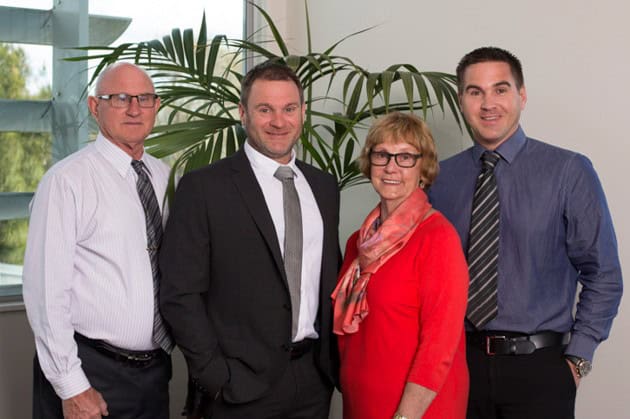
David, John, Joan & Richard Bayes.
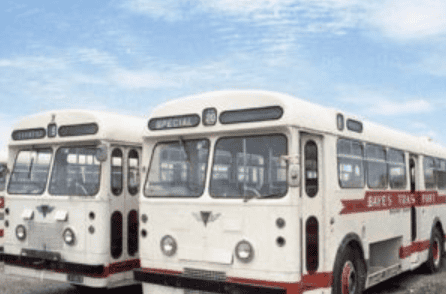
The early fleet
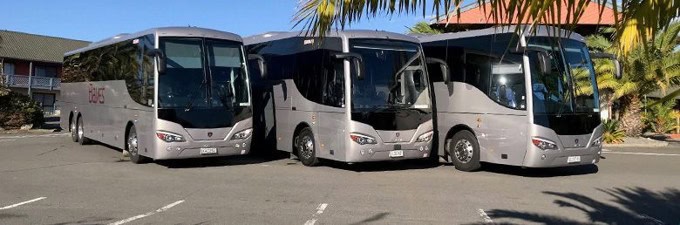
The modern fleet

Bayes Contracting
Joseph Bayes and Family in New Zealand
Extracts from Rushden Research - www.rushdenheartsandsoles.co.uk
Joseph Bayes was born in 1842 to Joseph Senior and his wife, Elizabeth, in Irchester, Northamptonshire, England and was one of 10 children. He died in 1925.
By 1871 Joseph junior was married and working as a master bricklayer and employing 2 men and a boy. He was a prominent worker at the Old Top Meeting in Little Street, teaching in Sunday School and for a short period he was church secretary.
Like his father, he was a builder and by 1880 he had been widowed twice, with one daughter from his first marriage to Mary Freeman and two small boys from the second marriage to Catherine White. He took as his third wife Eliza Colson aged 27, of Chelveston in 1881.
Many advertisements appeared at this time stating that tradesmen were needed in New Zealand and that land was very cheap.
He employed 4 men and 2 boys, but at the age of 38 he felt that there were too many builders in the town, it was time for him to look further afield.
The family of five, Joseph, Eliza, Annie, William and Arthur, discussed the advertisements of life in New Zealand and decided to emigrate and take up this challenge of starting a life at the other side of the world. The family packed up their belongings and prior to departure, stayed with a relation in Rectory Road, John Sargent .(John Sargent was the founder and first secretary of Rushden Temperance Society.) They were apparently, serene and behaved as though they were making a call before a short outing.
It is thought the family went by train from either Irthlingborough or Ditchford Station, but this is something which has yet to be determined in fact.
Because Joseph had a dread of fire, he chose to take a sailing ship (The Famenoth) as opposed to a steam ship to transport the family to New Zealand. They set sail on September 25th, 1882, on a journey that was to last 112 days.
After 112 days the Bayes family reached Auckland in New Zealand on Jan 14th, 1883. This is where they settled as a temporary measure until they were able to acquire land. Joseph busied himself with building and repair work around Auckland to begin with.
Joseph Bayes and family in 1887 at Red Beach. William holding Ellen (Nellie), Arthur (tragically killed in 1901) and Eliza holding baby Elizabeth.
In 1886 Joseph walked from Auckland and found a piece of virgin forest land, at Red Beach of 700 acres in extent at a price of 4½d an acre, a total cost of £13. 2s 6d. It had been a leasehold property in the care of a Mr. William Manning but a freehold was arranged and Joseph struck the deal. He then brought his family to the property by boat.
He must have been a good man of business, as he sold about half his holding shortly afterwards for 7½d. an acre, making a total of £10.18s 9d. This meant that his 350 acres had cost him £2. 3s. 9d. nett. The boundary of this block of property was, the full extent of Red Beach Road, along Whangaparaoa Road to the beginning of Vipond Road and then down to the sea.
The early years were very hard going. Joseph and Eliza worked together felling trees to make a clearance on which to raise cattle and build a livelihood. The family income consisted solely of the proceeds from dairy produce, timber and the gum from the root of the kauri tree. The holding was called Silverdale.
Joseph's craft in stone, brick and tiles could make little contribution in a land of timber buildings with corrugated iron roofs.
Four daughters were born to Joseph and Eliza within 10 years of their arriving in New Zealand. Ellen (Mrs Roper), Elizabeth (Mrs. Hames), Dora (Mrs. Wilkes) and Eva, who remained unmarried and was an invalid.
Regular correspondence was maintained between New Zealand and England which continued into the 20th Century and is ongoing.
Annie Bayes, Joseph's eldest daughter met a William Turley, on board the Famenoth and was married to him soon after reaching New Zealand. She had 9 children, one of whom died as an infant.
In 1901 their son Arthur, Joseph's second son, was thrown from a horse and sustained fatal injuries with resulting grief in the family.
Later in 1904 Joseph, who was never really a farmer at heart, Eliza and the younger members of the family moved to Takapuna near Auckland where they built one of the first brick houses in this growing city.
Son William remained at Silverdale to carry on the growing business and farming interest with Nellie (nee Gilshenan), his wife whom he had married in 1908, who became a mother of 6 sons and 2 daughters. This couple worked hard at breaking the land with the help of their family but always found time to 'praise the Good Lord for all his blessings.'
William died in 1944 and Nellie (Ellen) lived to be 101 and died in 1984. A very handsome brick seat has been built in her memory and is situated on the Red Beach waterfront. Red Beach has become a residential development with some of the roads, parks, and tennis courts being named after places in Northamptonshire, Rushden Terrace, Chelver(s)ton Terrace etc. (William Bayes Pl, Bayes Memorial Tennis Courts, Marellen Dr – named after Ellen/Nellie).
In the 1940's the farm was taken over by Mr. Ernie Bayes and subdivided later. The family is still in the area.
Joseph died at 14, Eversleigh Road, Takapuna on 25th September 1925 and was buried in "O'Neills Point Cemetery" on Tuesday September 26th, 1925, at 12 noon in Plot 006 Row D. Register entry 941. Aged 83.
Eliza died at 14, Eversleigh Road, Takapuna on April 16th, 1940, and was buried in "O'Neills Point Cemetery" on Thursday 18th April 1940 at 12 noon in Plot 006 Row D. Register entry 1228. Aged 86.
This family still retains its links with relatives in England into the 21st century.
Joseph Bayes and Family by Ann Cooper (2002)
This story is incomplete; I hope that one day the evidence will come to hand to complete it. There are many questions unanswered.
Whether or not I have proved a link with John the Baptist is problematical and the link with John Bunyan is somewhat a flight of fancy. For myself, I would like to think that John Bunyan had local links, as he is one of my heroes of all time, however I rather think that there must have been another catalyst locally, that started the Baptist Church.
Rushden is a fascinating place, as far as religion is concerned. There have been so many sects, chapels and Churches in this village, and I conclude that there must have been a great number of free thinking individuals in its past.
Joseph Bayes was obviously a very strong man, his confidence in going to the other side of the world shows his faith in God taking care of him and his family.
I have been unable to find out if he went on an "Assisted Passage" scheme, or whether he travelled independently. He must have had some capital from the sale of his home and business, so I think it pretty certain that he paid his own way.
Which railway station did he depart from? The family seem to think it was either Ditchford or Irthlingborough. The evidence we have is that members of the Baptist congregation assembled at the station and sang "God be with you till we meet again" to speed the family of its way. I hardly think they would have walked to either Ditchford or Irthlingborough, it would seem logical to me that Irchester was more likely the point of departure. We will have to wait and see if this information turns up. Having said this however, I have been told by an elderly, ex railway employee, that the agents that canvassed for customers for the "Assisted Passage" scheme, chartered whole trains to pick up their passengers at local stations and transport them to the ship head. So far, I have not been able to find out if this is correct, I will keep looking.
The log attributable to Joseph Bayes that is included in this document has an obvious error in the chronology. According to this document he saw Gough Island on November 20th, 1882, before crossing the line on the 24th of November. When it should have been the other way round, the line was crossed on November 4th and Gough Island on November 20th. This suggests that he either wrote the log after the journey had ended and got his paperwork mixed up or there was a mistake in a transcription somewhere down the line. The correct order of the journey is given in the account printed in the New Zealand Herald, presumably from the ships log, which would have been accurate as it was written up on an hourly basis.
What this document has proved to me is that Joseph Bayes was a Good Man and a good man of business. He bought 700 acres of land for £13.2s6d, sold half of it for £10.18s9d, making his remaining 350 acres cost him £2.3s9d. at a cost of just under 1 .l/2d an acre - not bad. I wonder what the developers of Red Beach paid for it?
It must also be said that faith in the almighty never left him and I finish this little tribute by entering here the words of a doxology, that no doubt Joseph Bayes must have sung many times.
Praise God, from whom all blessings flow, Praise Him, all creatures here below, Praise Him above, Ye Heavenly Host, Praise Father, Son, and Holy Ghost. Amen.
Ann Cooper, 2002
JOSEPH BAYES By Eric Parker
I will tell you all I know about Joseph Bayes of Rushden.
My Maternal Grandmother was Miss Elizabeth Sargent, (later Brooks) daughter of Thomas and Emma, and a relative of the Bayes family, also, her Uncle John Sargent had taken as his first wife Miss. Rebecca Bayes (Aunt Ree). I believe she was a sister of Joseph's; Rebecca lived in Little Street before her marriage.
The Bayes family were staunch Baptists, as were the Sargents. In September 1882 they ' would attend the "Top Meeting" in Little Street. Later, in 1901 the congregation moved to the present splendid Park Road Baptist Chapel, built by Frederick Bayes.
Joseph Bayes lived in the Wellingborough Road area. I am sure he was in the building trade, as were others in his family.
I was told that Eliza Colson was his third wife. He already had one daughter and two little boys when he married her. Work was hard to come by in the early 1880's and the decision to emigrate was made. Possessions dispersed, bedding packed, a cabin reserved on a sailing ship and a farewell meeting at the old chapel on the eve of their departure. Ardent and emotional were the prayers offered for them.
Below is an extract from the Sunday School Minute Book of this event:
6 September. Tea and meeting was held to give Mr. Joseph and Mrs Bayes and family an affectionate and prayerful farewell, who were leaving us for New Zealand.
The teachers left the school to present Mr and Mrs. J. Bayes Sept 21 to go to New Zealand when a testament was presented to them as an expression of the teachers love to them for the past and best wishes for their future well-being on the other side of the globe, which was written by the Pastor, Mr. Davis, then printed and framed.
They were to have a long, uncomfortable journey, as there were only primitive conditions on the ship.
My Great Great Uncle, John Sargent, suggested that Joseph kept a diary of the voyage, which he did and sent it afterwards to John who copied it, returning the original.
Many years later, after the death of Uncle John's second wife Sarah in 1943, old papers and rubbish were burning on a bonfire when my father, John Blunt, Sarah's executor, noticed an old school exercise book which he instantly retrieved from the flames and found to his delight that it was the diary of the voyage of Joseph Bayes. He had heard so much about him from my mother's old relatives.
I gave the late George Bayes the diary to take with him when he visited Australia (NZ?), presumably he left it with the family there.
John's daughter Eliza, lived with us until her death in about 1920, so you understand my interest.
I was always told that Joseph and Eliza had an unshakeable faith, that God would be with them if they believed in him and kept his commandments. Incidentally, the farewell chorus on these departures was "God be with you till we meet again," sung with great feeling (At the Railway Station).
Before the family set off for their distant Country, they stayed at my Great Great Great Grandfather's home in Rectory Road (John Sargent, Senior) for a last farewell. His two daughters, Ann and Eliza, said that they were serene and behaved as if they were making a friendly call before a short outing. Ann had been affianced to Joseph's Uncle, but he died of what was called "galloping consumption", an illness that was fatal in a very few weeks. I think the little family were setting off from Ditchford Station or possibly Irthlingborough.
I read the diary carefully and realised how well their Baptist discipline had prepared them for their undertaking, strictly teetotal, the Bible their guide to daily living. They had an arduous, dangerous journey.
Work was difficult to obtain when they arrived, and a home had to be built when they settled. Houses were of wood, not Joseph's native bricks or stone.
During the 1914-18 War, one of Eliza and Joseph's grandsons came to Rushden from France where he was in the army and he stayed with Uncle John and Aunt Sarah. He had a very good "leave" and I am glad to say he survived the "Great Slaughter".
Some years ago, I met descendants of Eliza and Joseph when they came to stay with Phyllis Sidey, grand daughter of John and Rebecca Sargent. She was The Park Road Baptist's missionary in India. I often see her daughter and two sons; they are 3rd or 4th cousins.
I believe that Joseph and Eliza were "fruitful and multiplied" and left a goodly progeny behind them and I am gratified that "The Old Top Meeting," founded by our forefathers, has had such a good influence in this land across the sea.
Joseph and Eliza never saw England again.
My Great Great Great Grandfather, John Sargent, was a founder and first secretary of Rushden Temperance Society, because he could read and write and was a devout Baptist.
Extracts from Rushden Research - Referenced pages:
https://www.rushdenheartsandsoles.co.uk/people/bayes-builders.html
https://www.rushdenheartsandsoles.co.uk/people/bayes-joseph.html
https://www.rushdenheartsandsoles.co.uk/people/bayesNZ.html
Remembering Red Beach of Yesteryear - Ken Bayes
Article on Stuff, North Harbour News - 09 March 2009
Red Beach long-time resident Ken Bayes, 85, writes about memories of the good old days growing up in Red Beach before the summer crowds moved in permanently.
I was so small that everything seemed large.
The big pohutukawa tree on Ngapara St, the big rock, the big cave between Red Beach and Stanmore, and the big waves which seemed to constantly pound the shore after regular gales from the east, sending balls of foam rolling up accessways and building up against fences and gates.
The wind was so strong, we ran to the hilltop and wearing raincoats we stretched out our arms and tried to take off like the seagulls. But after many a cropper, we gave up, the cows having given us some very disapproving looks.
The storms do not seem so severe now, compared with old photos showing trees bent back with salt wind.
All the old kauri forest roots below the big tree don’t get uncovered so much these days. The red shell is still there, thanks to the reefs at both ends of the beach.
Before my time, my brothers drove the cows along the beach, to drink springwater from the trough dug out of sandstone before wading through mud to the cowshed. It is near this trough that much of the iron comes out of the ground to colour the shells.
In February 1929, there was a defence exercise at Red Beach.
As a six-year-old I can just remember going up to the hilltop by Whangaparaoa Rd as we had to evacuate the house. The troops came ashore by the big tree, where headquarters were set up.
The two warships, Dunedin and Diomede, lay offshore while the battle went on, occasionally firing off blanks. For many years after this we heard pockets of unspent 303 cartridges going off while burning scrub to develop the farm.
Dad had a 12-foot kauri clinker-built dingy which he rowed to the far end of Stanmore Bay about once a year to clear around the Arkles graves.
I always went along and, on the way, back we called in at the Burns’ place for oranges. The oars were long and he took long slow strokes, but we got there all right.
It was in the same dingy that I later rowed my friends into the big cave. It was quite dark in there, but the sounds of your voices and echoes were great. I often thought it would be nice if you could sing in there.
Life was so quiet here in the winter, so that we would look forward to summer when the townies came out for their holidays.
The hay was cut and stacked before the campers put up their tents in both paddocks and the beachfront.
Many stayed the six weeks while the fathers went back to work.
The same folks came year after year, and many bought sections and built baches.
My father had a little shop where he sold groceries, milk and cream that my sister Mary looked after. I can still see my dad bending over picking peas for the shop at Christmas.
During those teenage years my spare time was taken up with fishing, surfing, flying kites and making our own fun.
Each year my brother Les and I went to Silverdale to get some nine by one boards to make surfboards, rounding the front and hollowing the back. They looked pretty good, but you could get a nasty jolt in the belly when the board hit the bottom.
Easter was the best time for this after the cyclone season.
The fishing was good.
We often set a line at night with two hooks, and in the morning before school, while dragging our toes through the sand to pick up the line, would find a snapper on each hook.
My grandfather bought most of the Red Beach property in 1886 and built a house in Marie Ave.
They planted seven pine trees and called them the seven sisters.
They planted crops and kept a few cows. But grandfather was a bricklayer and travelled around the district on horseback building chimneys.
Incidentally, my grandson Stefan is the sixth generation bricklayer.
While living there they made good use of the creek, paddling up and down in canoes.
In 1901 my uncle Arthur was thrown from a horse and killed, not far from the pohutukawa tree in Rushden Tce, so named after their hometown in England. He was buried at Silverdale.
It was such a shock they moved to Takapuna, leaving that part of the farm to my mother as a wedding present and the rest to dad.
There was a time I could never forget. It was during the Depression, and my father was in debt. Mother was in tears saying she had to leave her family of six sons and two daughters to work at Auckland Hospital.
Luckily it never happened as a gentleman named Colonel Sayer, who was a retired Indian army officer, and his Australian wife turned up and bought a portion of land off Viponds Rd leading down to the little waterfall at the beach. He was later curator of the Auckland Zoo.
He erected a huge marquee just above the bush beach which they lived in while building.
My sister Mary and I took them milk and cream, and we were fascinated by the foreign smells coming from within and the huge leopard skin on the floor.
Father later built a cottage there and called it Honeymoon Cottage where many couples spent happy times.
When my brother Arthur was breaking in the swamp paddock, where the Red Beach shopping centre now stands, there were huge gum holes.
We walked to school at Silverdale. We were fortunate in having such a good headmaster. Mr James A Colhoun with his assistant made a good job of teaching the 30 students.
Many a strapping I got, mainly for not paying attention, bad spelling or talking in class.
The war came, my brother Les went to fight in Egypt while I followed later to serve on North Atlantic and Russian convoys, luckily bringing home a lovely war bride from Northern Ireland called Lillian to live at Red Beach. But that’s another story.
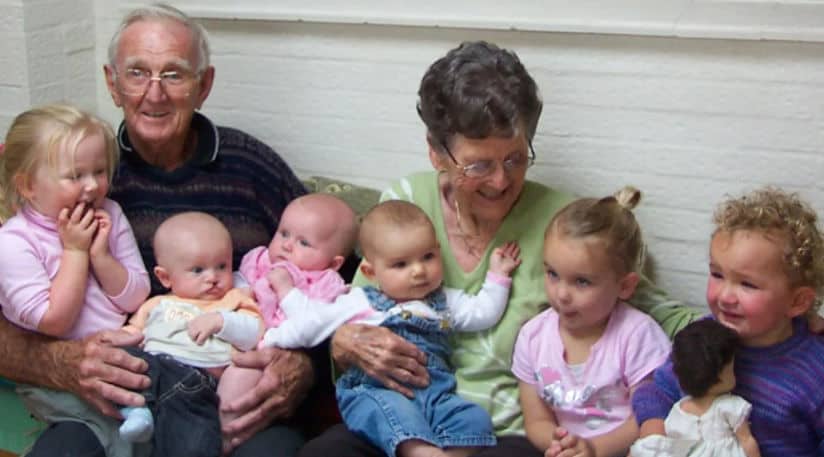
BAYES BABIES: Ken Bayes and his wife Lillian with their great-grandchildren, from left: Jade Abraham of Army Bay, Joshua Bayes of Red Beach, Ayla Abraham of Army Bay, Sophie Gillies of Lake Hawea, Casey Bayes of Red Beach, and Grace Gillies of Lake Hawea.
https://www.stuff.co.nz/auckland/local-news/north-harbour-news/787608/Remembering-Red-Beach-of-yesteryear